
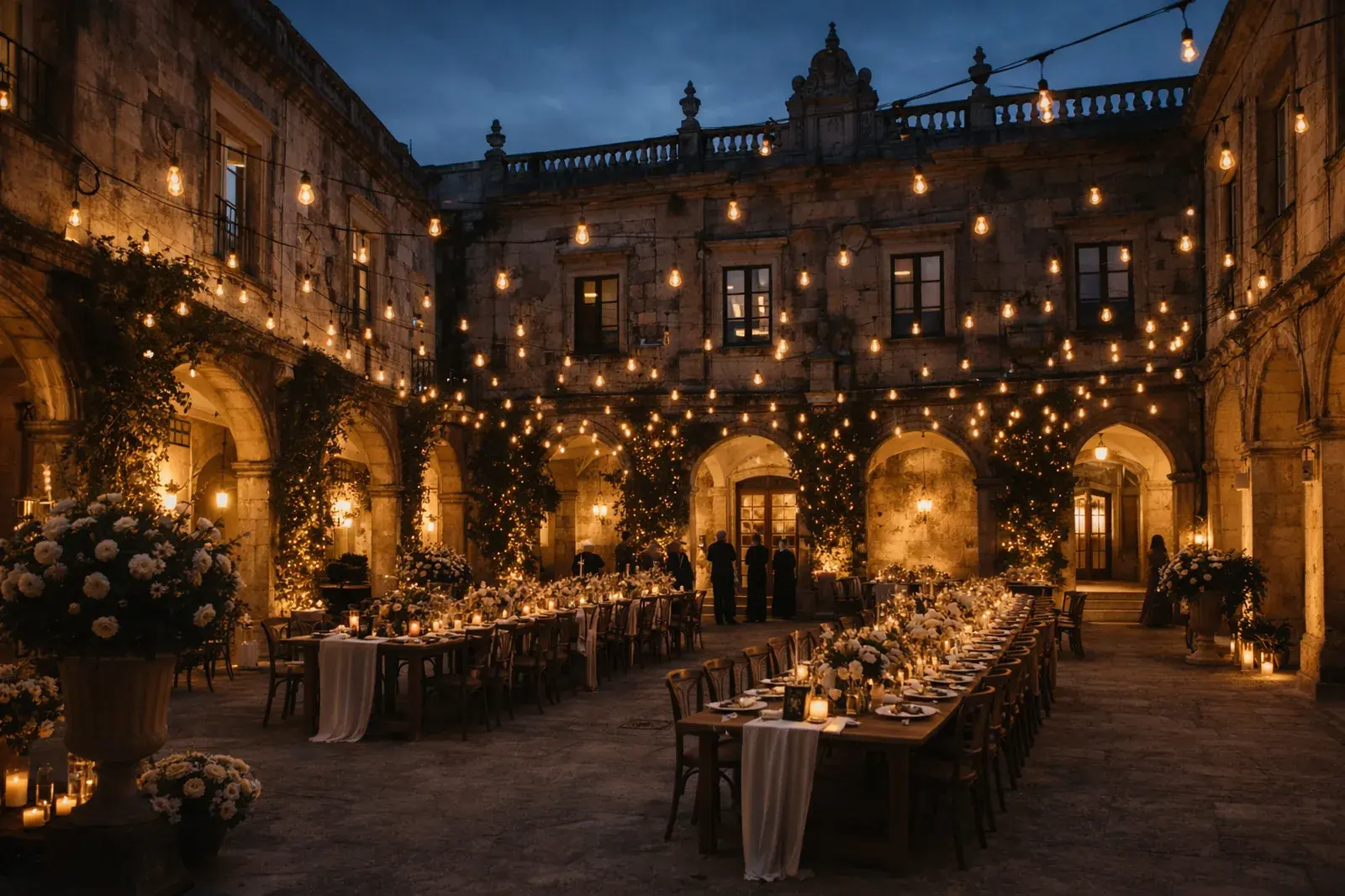
High-End Wedding Production in Portugal
Technical Execution and Structural Design for Luxury Celebrations
100%
In-house production
24h
Pre-event build access
3-Phase
Build methodology
Zero
Visible infrastructure
What is Wedding Production?
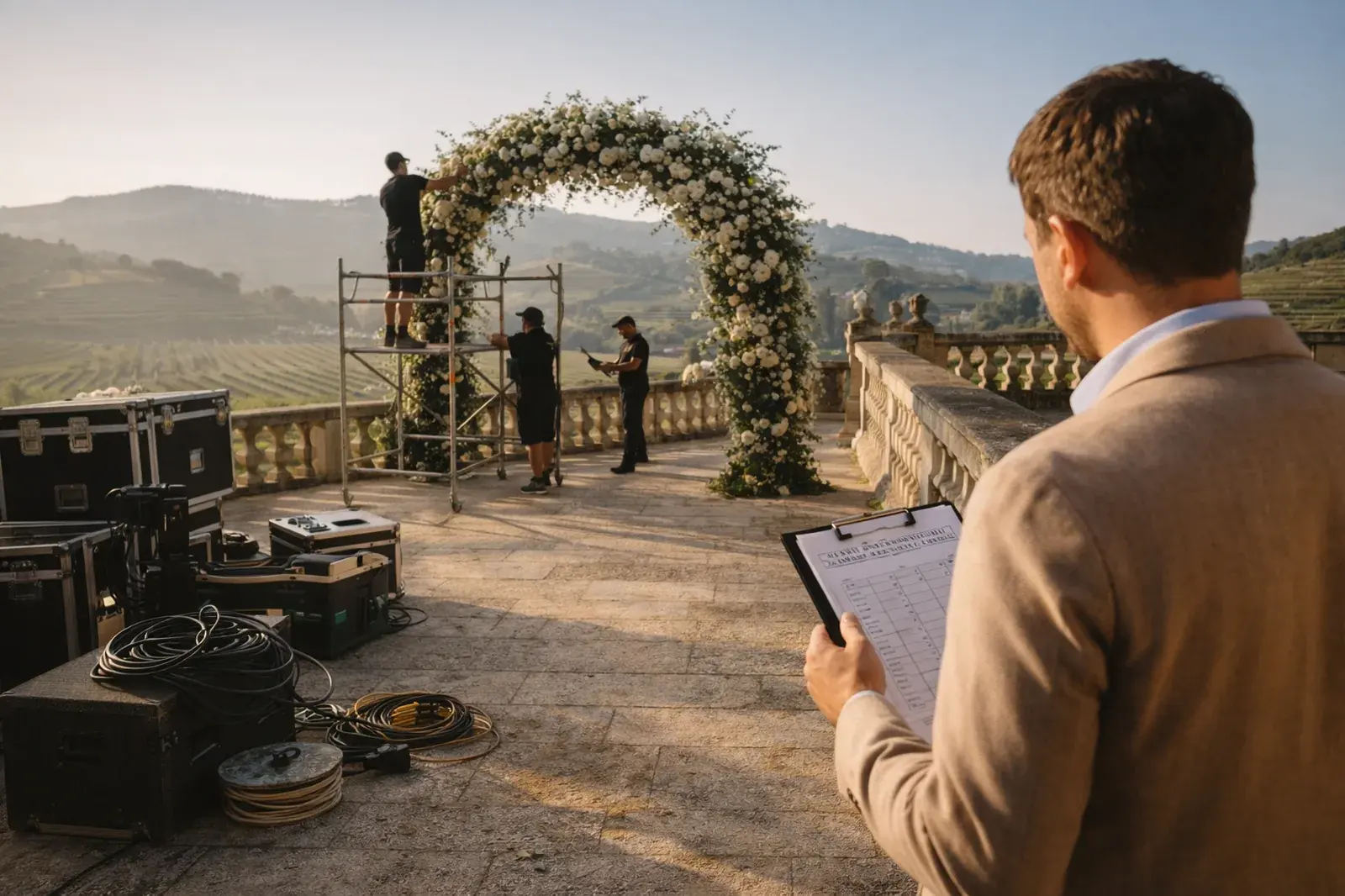
Wedding production is the technical and logistical infrastructure that transforms a venue into a functioning event environment — from initial structural assessment through load-in, execution, and final restoration. It is distinct from planning (which governs what happens and when) or creative direction (which shapes visual identity). Production is the "how" — the engineering layer that makes every other discipline possible.
Event Boutique is a production-first atelier. Where many wedding service providers treat production as a coordinating task, we treat it as a design discipline in its own right. Every venue has technical constraints and opportunities. Every celebration requires invisible systems: power distribution, structural load management, acoustic conditioning, emergency access, safety compliance.
We describe ourselves as an atelier, not an agency, because production expertise sits at the core of every project. When international couples choose to celebrate in Portugal — at a palace in Sintra, a clifftop in the Algarve, a wine estate in the Douro Valley, or a minimalist villa in Comporta — they are working with a team that has assessed and managed the technical reality of each venue type.
Our production teams manage approximately 12–15 celebrations annually, each typically spanning 2–4 days and involving 50–250+ guests. Budgets range from €70,000 to €250,000 or more. Project timelines allow 12–18 months for peak season dates (June–September), though we have delivered with shorter lead times when required.
The Six Production Disciplines
Luxury wedding production in Portugal integrates six core disciplines, each critical to the success of the celebration.
Structural Installations
The temporary structural framework that creates the event environment — stages, canopies, raised platforms, dance floors, custom-built seating areas, marquee structures, and bespoke installations unique to your venue and vision.
Outdoor venues and heritage palaces rarely offer ready-made event infrastructure.
In the Algarve, a clifftop ceremony requires weather-resistant platform engineering to withstand Atlantic winds.
A palace courtyard in Sintra may require elevated flooring to protect listed stonework or custom-built cover structure for inclement weather.
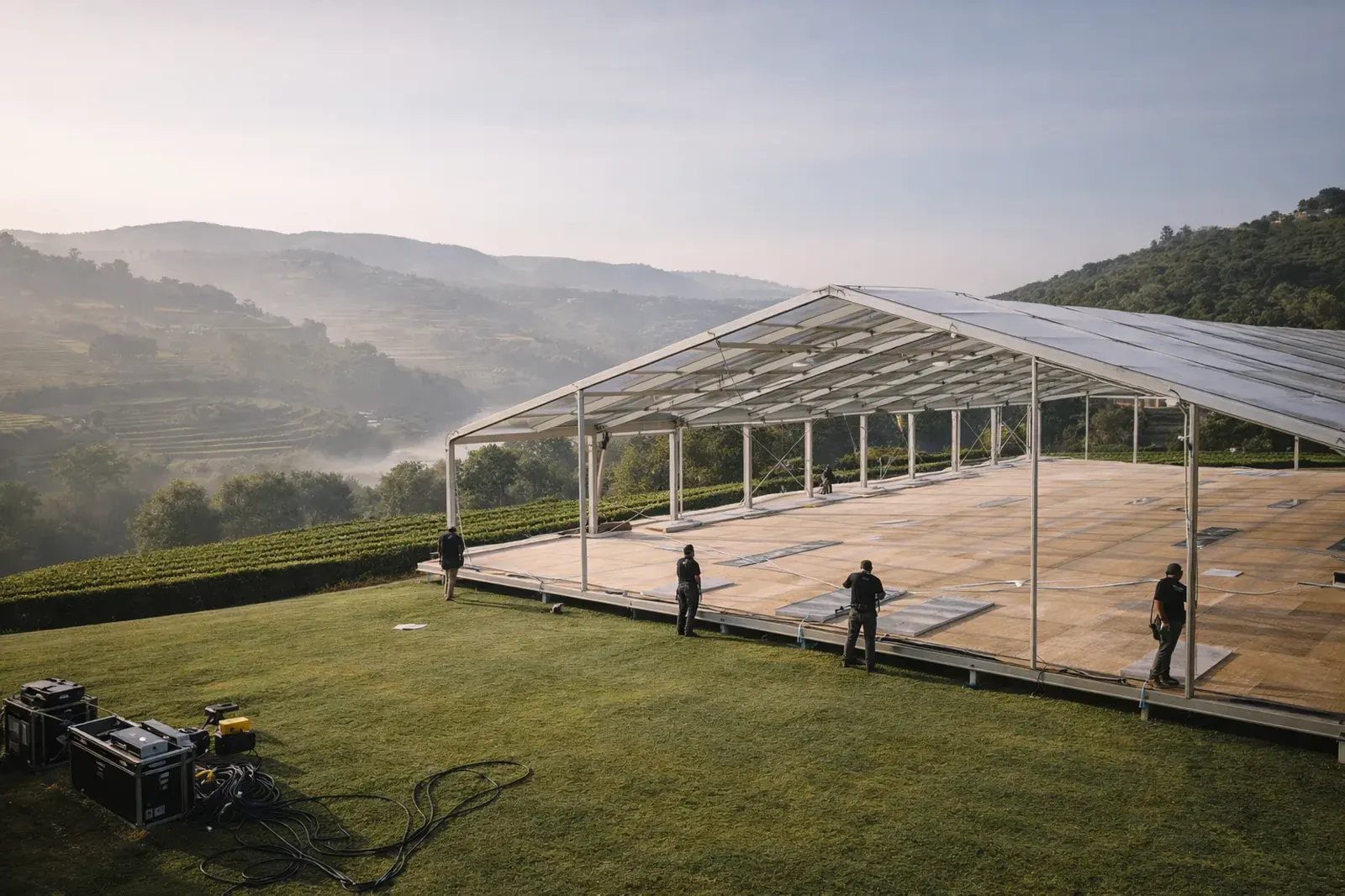
A wine estate in the Douro Valley may need complete ground preparation, access ramps, and stabilised surfaces.
Every structure requires load-bearing calculations signed by a structural engineer.
Heritage venues impose weight restrictions and prohibit drilling or permanent fixing — all structures must be self-supporting or secured with reversible methods.
Lighting Design
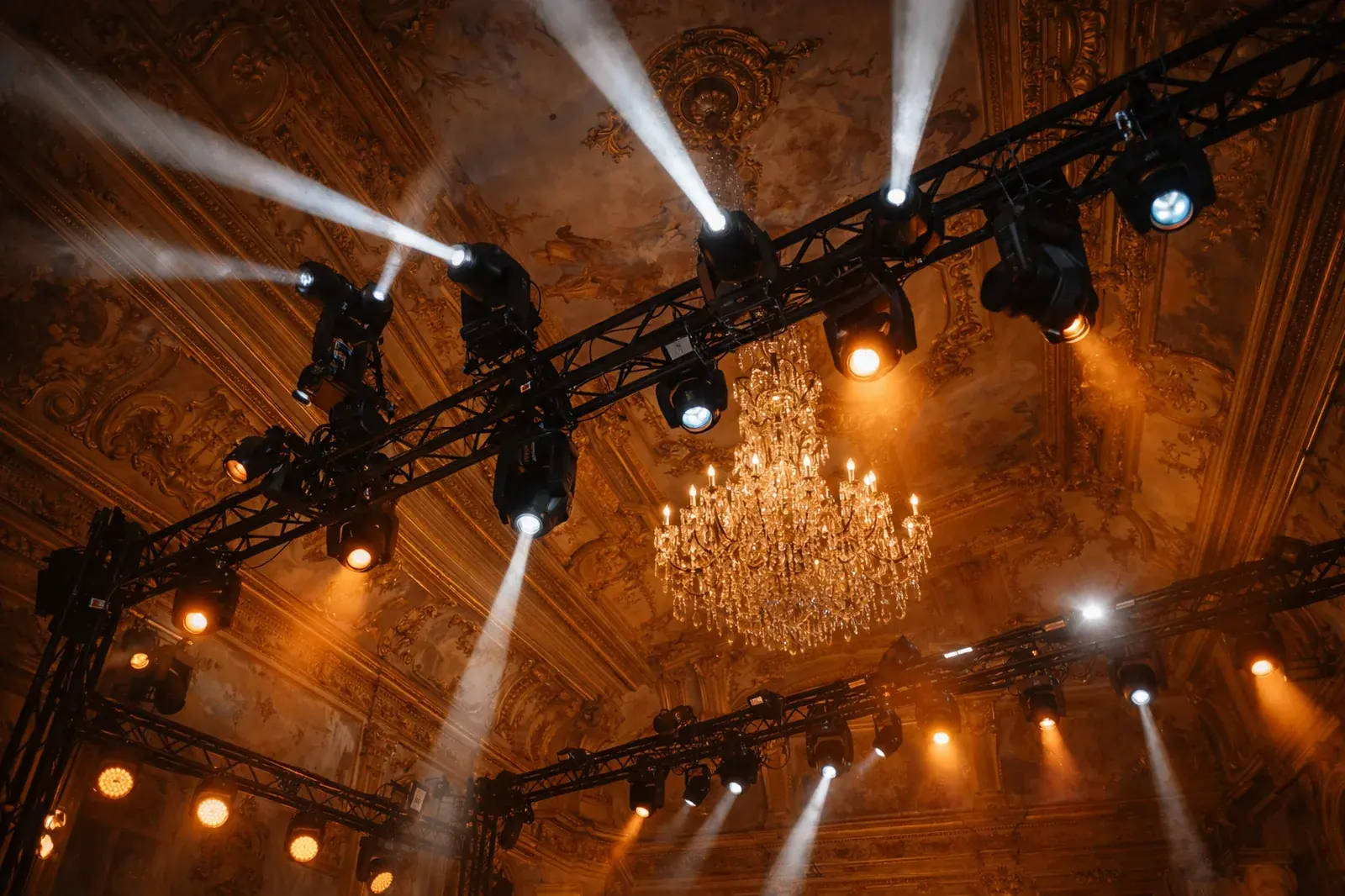
The complete illumination scheme — from functional task lighting to atmospheric design lighting that transitions ceremony to celebration.
Portugal's seasonal light changes dramatically: June 8 p.m. is near-daylight; December 5:30 p.m. is darkness.
Lighting design must account for natural light hours, backup generator capacity, electrical load distribution, and aesthetic integration.
A clifftop venue demands ocean-edge safety lighting and glare management.
A palace interior requires preservation of heritage architecture while creating contemporary atmosphere.
Typical luxury wedding productions require 40–80 kW of installed lighting capacity depending on venue size.
Colour temperature (warm 2700K for intimacy, cooler 4000K for task areas) is designed during creative direction and programmed into the technical schedule.
Sound Engineering
The complete audio environment — ceremony reinforcement, microphone placement, ambient sound systems, DJ or live music amplification, and noise compliance management.
Portugal's heritage venues often occupy spaces with complex acoustics — vaulted ceilings, stone walls, irregular room geometry.
Outdoor venues present acoustic challenges: wind noise, guest conversation absorption, natural reverberation.
Many Portuguese municipalities enforce strict noise curfews (typically 10 p.m. or 11 p.m.).
Heritage palace venues may restrict microphone positioning or speaker placement due to listed building protection.
Typical systems range from 10–20 kW of installed PA capacity.
Sound technicians remain on-site throughout the event for real-time mixing.
Power & Infrastructure
The complete electrical and utility infrastructure — generator sizing, cable distribution, water supply, sanitation facilities, climate control, and backup systems.
Not all venues have adequate permanent power. Remote estates typically require temporary power generation.
Generator capacity must exceed peak load by a safety margin, typically 30–40%.
A typical 150-guest luxury wedding requires 40–100 kW of generated power depending on scope.
Water systems must be inspected and certified for safe potable use.
Power distribution involves cable runs (often underground or floor-protected) from generators to lighting, AV, kitchen, and climate systems.
All electrical systems are inspected by a qualified technician before guest arrival.
Build Logistics
The operational management of load-in, installation sequencing, equipment staging, vehicle access coordination, crew deployment, and safety protocols during the build phase.
Load-in is compressed time — typically 36–72 hours to install complete structural, lighting, sound, and catering infrastructure.
Vehicle access routes, staging areas, and timeline sequencing must be choreographed precisely.
Heritage venues often restrict working hours or vehicle access routes.
Large productions employ 20–40+ crew members across specialties.
Load-in schedules break into phases: initial site preparation, structural installation, MEP (mechanical, electrical, plumbing), lighting rig assembly, sound system installation, catering setup, and final safety check.
All crew members receive site-specific safety briefings documenting emergency exits, first aid locations, and incident protocols.
Safety & Compliance
Structural engineering sign-off, fire safety certification, emergency access verification, Portuguese municipal permits, insurance compliance, and ongoing safety management.
Portuguese municipalities require formal approvals for events involving temporary structures, power generation, or significant guest numbers.
Insurance underwriters require structural engineering certification for custom-built installations.
Fire safety codes govern maximum occupancy, emergency exits, and first aid provision.
Heritage venues fall under additional regulatory frameworks that impose stricter requirements.
All custom structures require a structural engineer's signed certification.
Emergency access routes are verified and protected. First aid facilities are staffed with certified professionals.
"The most sophisticated production is invisible to guests. Every system works flawlessly — that invisibility is not accident, it is craft."
Production Across Portugal's Venue Types
Every venue category — heritage palace, garden estate, coastal clifftop, remote wine region — presents distinct production challenges. Designing production means working within constraints rather than against them.
Heritage Palaces and Listed Buildings
Venues like state palaces in Sintra or private palaces in Lisbon and Cascais operate under strict heritage protection frameworks.
No drilling, no adhesive fixing, no heavy point loads on floors.
All structures must be self-supporting or secured with reversible methods (weights, clamps, tension systems).
Flooring protection — temporary floor coverings — preserve original surfaces.
Weight distribution is calculated precisely; concentrated loads are spread across multiple support points.
Heritage venues typically require the longest lead times (18+ months).
Outdoor and Garden Venues
Estates with extensive gardens, vineyards, or landscape grounds offer visual beauty but require complete infrastructure build.
Ground conditions vary — clay, sandy soil, grass, gravel.
Ground preparation (levelling, surface stabilization, drainage) precedes structural installation.
Weather contingencies dominate production planning: coverage for ceremony, rain-specific pathways, sun protection.
Lighting must function independently of natural light; generator power is typically required.
Water access may require temporary supply systems.
Coastal Clifftop Venues
Portugal's Algarve coast — dramatic limestone cliffs, Atlantic views, salt-laden air — presents specialised production challenges.
Wind exposure requires structural engineering specifically for coastal loading.
Structures must withstand sustained winds of 40+ kph.
Metal fittings are susceptible to salt corrosion; all exposed metal uses stainless steel or marine-grade materials.
Power supply logistics may require generator installation at distance from guest areas.
Safety barriers around cliff edges are non-negotiable.
Remote Wine Estates and Rural Quintas
Douro Valley wine estates, rural wedding quintas, and converted farmhouses offer landscape drama but minimal permanent infrastructure.
Power generation (one or more generators) is essential.
Water supply may require temporary holding tanks or certified tanker delivery.
Sanitation requires temporary facilities with professional servicing.
Road access is often narrow; vehicle logistics require careful planning.
Dark-sky considerations guide lighting design philosophy.
How We Produce a Luxury Wedding — The Complete Process
Every Event Boutique production follows a structured nine-step process, beginning with technical assessment and concluding with final venue restoration.
Conduct Technical Site Assessment
4–6 hours on-site
Our production team visits the venue with specialized equipment — power testing, acoustic measurement, ground condition assessment, load-bearing evaluation, and structural documentation. We identify available permanent power, water supply quality, sanitation requirements, load-bearing capacity, acoustic properties, natural light conditions, vehicle access routes, heritage restrictions, emergency access, and fire safety baseline.
Develop the Production Overlay
2–3 weeks
With site data in hand, we develop a 'production overlay' — technical drawings layered onto the venue plan, showing structural installation footprints, lighting rig positions, sound system placement, generator positioning, water and sanitation locations, emergency access routes, and load-in vehicle movement patterns.
Source and Brief Specialist Vendors
4–6 weeks
With the production overlay approved, we source specialist vendors: structural engineers, lighting designer teams, sound engineers, generator suppliers, catering equipment providers, sanitation suppliers, and safety consultants. Each vendor receives detailed technical brief with production overlay, site assessment data, event schedule, and performance requirements.
Create the Build Schedule
Shared with all vendors
The build schedule is a minute-by-minute timeline governing load-in, installation, rehearsal, and event day logistics. It covers Days 1–3 load-in and installation, Day 4 rehearsal and dress, event days from first guest arrival through final departure, and strike and restoration phases.
Manage Municipal Requirements and Permits
8–12 weeks advance
Event Boutique handles all required municipal and regulatory submissions: noise permits, structural permits, assembly permits, fire safety certification, and special permissions for heritage venues. We track deadlines, coordinate inspections, and ensure all certifications are in place before load-in.
Execute Load-In and Installation
1–3 days
Load-in typically spans 1–3 days depending on production scale. Our production team oversees vehicle access coordination, site preparation, structural installation, electrical installation, lighting rig assembly, sound system installation, water and sanitation setup, catering infrastructure, and final safety walk-through.
Direct Technical Rehearsal
12–24 hours pre-event
Before guests arrive, a full technical rehearsal confirms every system: sound check with all microphones tested, lighting walk-through with colour schemes and cue rehearsal, service choreography with staff pathways, timeline confirmation with all vendor teams, and contingency review for weather and emergencies.
Oversee the Live Event
Duration of event
From first guest to last, our production manager and technical team remain on-site overseeing guest flow management, real-time problem solving, timing adherence, service quality optimization, and safety monitoring. For multi-day celebrations, we coordinate reset logistics between event days.
Complete Strike and Restoration
2–4 days
After the final guest departs, the strike phase begins: equipment removal, venue restoration, final walkthrough with venue management, and vendor demobilisation. For heritage venues, this phase is particularly meticulous, ensuring the venue shows no evidence of the production one week after conclusion.
Why Production Matters for Destination Weddings
Feasibility Assessment
A couple envisions a stage canopy for the ceremony. Without production expertise, the planner says yes. With production expertise, we conduct load-bearing assessment, determine palace compliance, calculate required structural engineering, and confirm delivery vehicle access. The proposal is then realistic and deliverable.
Budget Precision
Production expertise translates visions into specific cost drivers. A couple wants outdoor ceremony lighting. Without analysis, this is vague. With production, we know the venue requires specific uplights at certain spacing, power distribution requires specialized cabling, a backup generator is necessary, and a lighting technician must remain on-site. The cost is precise, with no surprises.
Risk Mitigation
Portugal's heritage venues operate under strict regulatory frameworks. Coastal venues present wind engineering challenges. Remote estates have limited infrastructure. Production expertise identifies these constraints early, in the planning phase, when options still exist. A production-first approach means saying the palace permits structures under 500 kg each — constraints that shape creative solutions.
Safety and Compliance
Portuguese municipal permits, fire safety codes, and structural engineering requirements are non-negotiable. Production expertise ensures all required certifications are obtained, all safety systems are properly installed and tested, and emergency protocols are in place. Guests can celebrate without concern about underlying compliance.
Invisible Excellence
The most sophisticated production is invisible to guests. The power system works flawlessly — no lights flicker, no sound cuts out. The structural installation feels like part of the venue. The climate is comfortable. The bathrooms function seamlessly. This invisibility is not accident; it is the result of meticulous production planning and execution.
For destination celebrations — where the couple cannot oversee every detail themselves — production expertise is the difference between a successful event and one compromised by logistical failures.
Frequently Asked Questions
YOUR PRODUCTION REQUIREMENTS
Discuss Your Production Requirements
Every celebration starts with understanding what's technically possible at your chosen venue. Share your vision, your guest list, your preferred regions — and we'll conduct a thorough production assessment to confirm feasibility and scope.
Or explore our complementary services:
Wedding Planning & Management
End-to-end coordination and production oversight
Creative Direction
Visual identity and spatial design informed by production realities
Wedding Coordination
On-site leadership and guest experience management
Venue Database
Search heritage palaces, estates, and gardens we know intimately